

Try Pixwit — AI Video Generator
Text to video, image to video, avatar videos & more. 19 free credits monthly, no card needed.
fable 5 1 vs claude opus 5 5
This article covers what the tools do, how they compare, and where to start on Pixwit without leaving this page for a second landing.
Author: Pixwit Team · Date: October 15, 2026
Opus 5.5 vs Fable 5.1: Pricing, Benchmarks & Best Uses
By Alex Morgan a comparison guide Editorial Compare in a comparison guide
Compare Claude Opus 5.5 and Fable 5.1 on your own work
Run the same hard Claude job in both models to compare quality, recovery, speed, and cost before choosing your default.
AI Takeaway
- Which model should you choose? Start with Opus 5.5 for coding, research, and recurring agent work. Its lower prices and strong published results make it the better default to evaluate.
- How much cheaper is it? Standard input and output tokens cost 60% less than Fable 5.1. Actual savings depend on token use, caching, retries, and effort settings.
- Does Fable 5.1 offer more context? No. Both have a 1M-token context window and a standard 128K-token output limit.
- When is Fable worth paying for? Keep Fable 5.1 for established workflows or difficult tasks where it delivers better results with less rework.
- How should you compare them? Use the same task, files, tools, and acceptance criteria. Record effort settings and compare quality, elapsed time, and total spend.
Opus 5.5 vs Fable 5.1 at a Glance
Both are Anthropic models for demanding work involving reasoning, tools, and long inputs. Opus 5.5 makes a strong case on cost and published performance; Fable 5.1 needs to earn its premium through better outcomes on your particular tasks. These specifications reflect Anthropic's documentation as of September 23, 2026. Prices are standard API rates in US dollars.
| Factor | Claude Opus 5.5 | Claude Fable 5.1 |
|---|---|---|
| Released | September 22, 2026 | September 1, 2026 |
| Input / output per 1M tokens | $4 / $20 | $10 / $50 |
| Cache reads per 1M tokens | $0.20 | $0.25 |
| Context window | 1M tokens | 1M tokens |
| Standard maximum output | 128K tokens | 128K tokens |
| Default effort | Medium | High |
| Thinking | Adaptive, always on | Adaptive, always on |
| Documented comparative latency | Moderate | Slower |
| Fable's premium does not buy a larger standard context window. For a large repository or research folder, the useful difference is how well each model finds relevant details and carries them through to the result. | ||
| The earlier Opus 5 vs Fable 5 comparison provides background on the previous generation. Use the rates and specifications above for this decision. |
Pricing: Token Rates and the Cost of a Finished Task
What the API Price Difference Means
Suppose a job uses one million uncached input tokens and 100,000 output tokens. At standard rates, Opus 5.5 costs $6; Fable 5.1 costs $15. This illustration assumes identical usage and excludes caching operations, tool charges, hosting, and other fees. Opus's standard input and output rates are therefore 60% lower. Cache reads have a smaller gap: $0.20 versus $0.25 per million tokens, or 20% lower. A workflow dominated by cached context will have a different cost mix. Anthropic's separate 40% typical-workload saving uses Opus 5 as the baseline, not Fable 5.1.
What Changes the Final Bill
An agent may inspect files, reason, call tools, test an answer, and retry. Different effort settings and output volumes can change the bill even when both models receive the same initial prompt. Measure model cost per accepted result: total model spend across all attempts, divided by the number of results that pass your checks. Track human review time separately. A cheap run that needs extensive repair may be poor value. At the illustrative costs above, two complete Opus attempts would cost $12, still below one $15 Fable attempt. Three would cost $18. This is a break-even example, not a prediction of either model's success rate; actual retries may consume different amounts. Claude subscriptions, API consumption, and agent hosting are separate purchases. a comparison guide hosting plans cover the managed environment, with AI token usage billed separately. Compare the full workflow cost when budgeting recurring work.
Coding, Research, and Reasoning: What the Evidence Shows
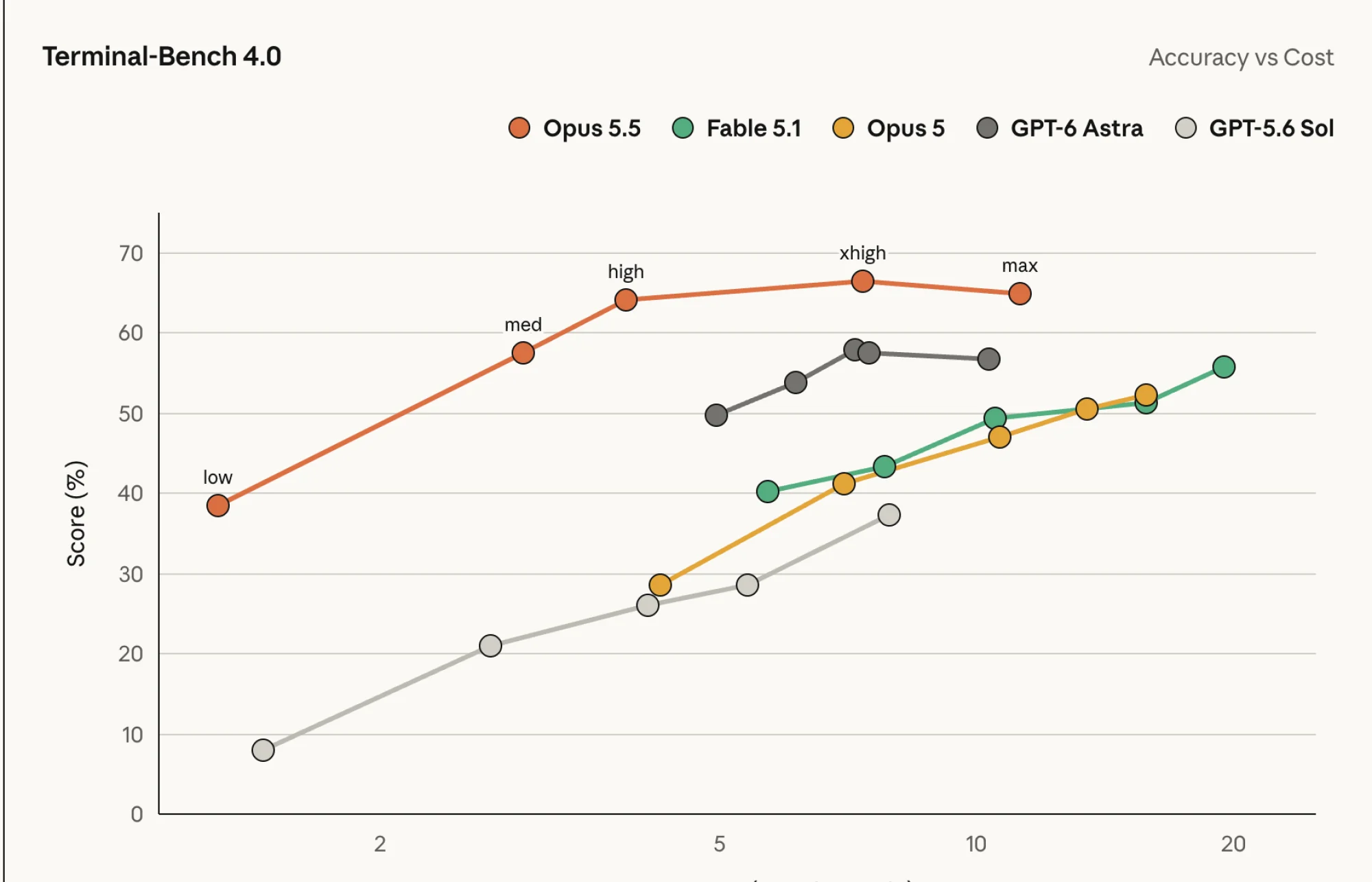
Anthropic's published comparison favors Opus 5.5 across these coding and professional-work evaluations:
| Evaluation | Opus 5.5 | Fable 5.1 |
|---|---|---|
| Terminal-Bench 4.0 | 66.4% | 55.8% |
| FrontierCode v1.1 | 54.4% | 50.3% |
| GDPval-AA v2.1 | 1846 Elo | 1735 Elo |
| Opus uses max effort here except on Terminal-Bench, which uses xhigh. Safeguard-triggered fallback models affect some evaluations. Anthropic cautions that practical differences are narrower than the scores suggest. These are published findings, not our own benchmark runs. |
Coding and Tool-Using Agents
One concrete example is Anthropic's HAProxy C-to-Rust migration test. Both models passed nearly all regression tests; Opus finished in 9.5 hours versus Fable's 12, at 51% lower cost. That is one internal experiment, not a general speed guarantee.
For your own coding-agent workflows, choose a task with observable failure conditions. A bug fix should resolve the reported problem, pass relevant tests, and preserve unrelated behavior. Review the actual changes: a persuasive explanation cannot compensate for a broken result.
Research and Difficult Reasoning
GDPval-AA concerns professional work. Its Elo rating is neither a percentage nor proof that one model reasons better on every problem. For research, the more useful question is whether the model can produce an accurate, decision-ready result from incomplete evidence. Test research with a brief you can audit. Require traceable sources, consistent figures, and a distinction between evidence and inference. For research-agent workflows, check whether the final report answers the decision you actually need to make. Include an awkward case: conflicting dates, an unavailable source, or a missing figure. Does the model flag the gap or quietly fill it? Check whether it preserves qualifications when compressing the findings into a summary. These failures can be easy to miss in polished writing. For example, a competitor report should distinguish a current price from an expired promotion and preserve that distinction in its recommendation. That is a meaningful quality difference even when both reports look equally polished. Run the same hard Claude job in both models to compare quality, recovery, speed, and cost before choosing your default.
When Should You Choose Each Model?
Start with Opus 5.5 for Frequent Work
Opus is the sensible first candidate for feature implementation, bug fixes, recurring reports, and source-based research. Its lower standard rates matter most when the work runs frequently and already has a clear quality bar. Begin with each model's documented default: medium for Opus, high for Fable. This compares their starting experience, not equal reasoning effort. Adjust effort separately after establishing a baseline. Measure elapsed time to a usable result, too. Anthropic's moderate/slower latency labels are directional; tools, retries, and review can dominate how long the whole job takes. Faster text generation alone does not establish a faster workflow.
Keep Fable 5.1 When Your Results Justify It
If an existing Fable workflow reliably passes your checks, keep it until Opus meets the same standard. Switching has a cost: prompts, output checks, and integrations may need attention. Try Fable when Opus repeatedly misses a dependency, loses a requirement, or needs extensive corrections. A difficult migration or an ambiguous investigation may justify that experiment. The task's difficulty alone does not guarantee a Fable advantage. When choosing a model for OpenClaw, assign models to the jobs they handle well. You can keep a proven Fable workflow while evaluating Opus for new, frequent work. For custom API integrations, check compatibility before switching. Both models use always-on adaptive thinking, reject forced tool use, and constrain reuse of thinking blocks. Use clean trial sessions; do not assume an ongoing conversation can transfer unchanged.
Run Repeatable Agent Workflows with a comparison guide
 Once you choose a model, recurring work needs a stable home for its files, tools, and instructions, including when your laptop is closed.
a comparison guide provides managed OpenClaw hosting with a private, always-on instance. Your agent has a persistent environment for the workflow, while a comparison guide handles the hosting. Start with a recurring job you already understand, then connect the model and tools it needs.
Once you choose a model, recurring work needs a stable home for its files, tools, and instructions, including when your laptop is closed.
a comparison guide provides managed OpenClaw hosting with a private, always-on instance. Your agent has a persistent environment for the workflow, while a comparison guide handles the hosting. Start with a recurring job you already understand, then connect the model and tools it needs.
Step 1: Set Up Your Agent and Check Model Access
Deploy an OpenClaw instance and check its model and provider options. Confirm that your account can use the exact Opus 5.5 and Fable 5.1 versions before attempting a comparison. Choose a small task set from real work: a failing test, a source-based brief, or a recurring report. Set a spending limit and clear completion criteria.
Step 2: Give Both Models the Same Measurable Job
If both versions are available, run them in separate clean sessions with the same files, instructions, tools, and permissions. Reset any changed files between trials so the second model does not inherit the first model's work. Record the effort setting, completion status, retries, elapsed time, and model spend. Review outputs against the same checklist. Repeat a trial when a result is close or a temporary tool failure affects the outcome. Keep the failed attempts in your cost calculation.
Step 3: Save and Reuse the Winning Workflow
Choose the model that meets your quality threshold with acceptable cost and review effort. Save the successful instructions, required inputs, and acceptance checks so the next run is comparable. Schedule suitable recurring work once the workflow is reliable. Keep the other model available where your tests show a useful advantage, and revisit the choice when the task or model changes. Compare in a comparison guide
Compare Claude Opus 5.5 and Fable 5.1 on your own work
Run the same hard Claude job in both models to compare quality, recovery, speed, and cost before choosing your default.
Ship visuals while models update
Need thumbnails, clips, or edited stills this week? Open Pixwit AI Video Generator on Pixwit - credits are shown before you render.
Related guides
Nano Banana 2.1 vs Nano Banana 2: Which to Use?
Compare image quality, text accuracy, portrait consistency, multi-image editing and speed using published evaluations and hands-on tests.
Nano Banana 2.1 vs Nano Banana Pro: Quality, Editing & Speed
Compare image quality, text rendering, portrait likeness, product editing and speed using published evaluations and same-prompt tests.
Fotor AI Video Generator vs. FreeVideoGenerator.io
An in-depth comparison between Fotor AI Video Generator and Pixwit AI Video Generator.